











Press Releases, Industry Insights Blog
Seventh Edition of the “TOP 100 Cross-Border Marketplaces Europe” Report: European Marketplace Commerce Enters a New Era
Brussels – 15th October 2026. Cross-Border Commerce Europe, the authoritative platform driving cross-border e-commerce in Europe, has released the seventh edition of its “TOP 100 Cross-Border Marketplaces Europe” report. The study reveals how AI, specialization, global competition and regulation are reshaping the European marketplace landscape. A study conducted by CBCommerce with the support of FedEx Express, Mondial Relay and Poste Italiane.
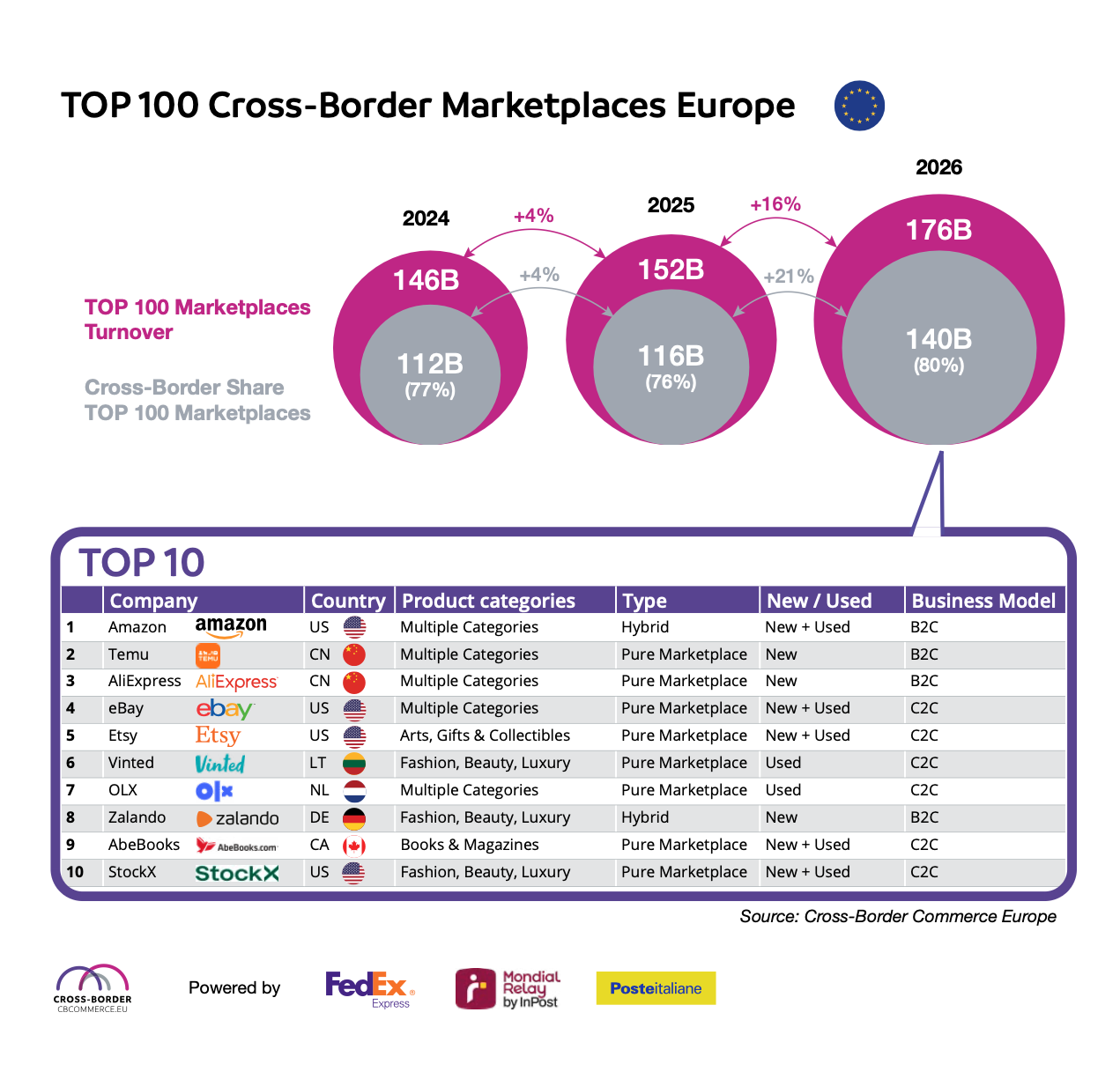
In 2026, the TOP 100 marketplaces selling in Europe generated an estimated €175.8 billion in gross merchandise value (GMV), including domestic and cross-border sales. Of this total, €139.8 billion, or 79.5%, came from cross-border transactions. These figures underline the importance of marketplaces in connecting buyers and sellers across European borders.
Looking ahead to 2027, the total GMV of Europe’s TOP 100 cross-border marketplaces is projected to grow by approximately 8% to €190 billion. Cross-border GMV is expected to increase by 10% to €154 billion, representing approximately 81% of total marketplace GMV. Growth will be driven by AI-powered product discovery, continued international marketplace expansion and increasing investment in local fulfilment infrastructure across Europe.
Prominent players like Amazon, Temu and AliExpress lead the TOP 100 ranking, followed by eBay and Etsy. The marketplace ecosystem remains highly competitive as global platforms invest in European infrastructure and local fulfilment. Meanwhile, AI-powered discovery and social commerce are changing how consumers find products, and regulatory requirements are adding operational complexity. As the market matures, success increasingly depends not simply on reaching more countries, but on combining the right marketplaces, technology, logistics and customer propositions.
The TOP 10 Marketplaces in this report are:
- Amazon
- Temu
- AliExpress
- eBay
- Etsy
- Vinted
- OLX Group
- Zalando
- AbeBooks
- StockX
The TOP 100 eRank is a relevance ranking based on the careful weighting of four primary parameters that measure each marketplace’s cross-border relevance and performance:
- Cross-border online sales across 28 European countries, including the UK, Switzerland and Norway
- SEO indicators for cross-border performance
- Coverage of countries (cross-border score)
- Volume and percentage of cross-border visits
The above-mentioned criteria are combined with secondary weighted parameters:
- Marketplace business models (B2B, B2C, P2P, C2C); pan-European brand strategies; AI & Big Data strategies; services offered to customers; and marketplace type (hybrid or pure), including third-party seller participation and cross-border GMV potential.
By 2026, marketplaces increasingly underpin international commerce, from discovery and logistics to payments and marketing. Europe’s diverse consumers, languages and regulations make cross-border expansion promising but operationally demanding.
Three main models dominate
- Generalist marketplaces (e.g., Amazon, Allegro, Bol) – broad assortments, infrastructure and consumer reach, but fierce price and visibility competition.
- Vertical marketplaces (e.g., Zalando, ManoMano, ASOS) – category-focused, curated channels with stronger brand relevance but selective access.
- C2C marketplaces (e.g., Vinted, Depop, Wallapop) – peer-to-peer resale and community-led discovery, with low entry barriers but less brand control.
Model choice is strategic: generalists offer scale, verticals enable targeted positioning and C2C fosters resale. Brands increasingly combine these models within a deliberate marketplace portfolio, balancing growth, relevance and operational control.
Four trends reshape marketplace growth
AI-powered discovery. AI assistants are increasingly helping consumers research, compare and select products before they visit a marketplace. For brands, accurate product information, pricing, availability and reviews are becoming essential for visibility in AI-generated recommendations.
Social commerce. Creators, short-form shoppable videos and social platforms are bringing product discovery and transactions closer together. Early European growth is especially driven by creator-led content, giving marketplaces and retailers new ways to reach customers beyond traditional search.
Local fulfilment and global competition. International platforms are expanding their networks of European sellers, warehouses and delivery partners. This localisation can improve speed and reliability while helping marketplaces adapt to changing customs rules and increasingly price-sensitive consumers.
Regulatory readiness. Customs reforms, VAT, extended producer responsibility (EPR) and packaging requirements are adding complexity to cross-border trade. Transparent prices, reliable delivery and more automated compliance processes are becoming important capabilities for sellers operating across multiple European markets.
“I would like to extend my thanks to our market research team and our partners, FedEx Express, Mondial Relay and Poste Italiane, for this seventh edition of the “Top 100 Online Marketplaces in Europe” report. This initiative enhances transparency within the European online marketplace sector and drives cross-border growth across the entire industry,” concludes Carine Moitier, founder of CBCommerce.EU.


[addtoany]
Thanks to our Partners
CBCOMMERCE NETWORK
FOLLOW US
NEWS FROM EXTERNAL SOURCES
[wp-rss-aggregator template="widget"]
CURRENCY TREND IN REAL TIME
EUROPE ECONOMIC CALENDAR
Browse the latest Retail and eCommerce News and Insights
CBCOMMERCE NETWORK
FOLLOW US
NEWS FROM EXTERNAL SOURCES
[wp-rss-aggregator template="widget"]
Latest Retail and eCommerce News / Insights